



Full guide to standards, grinding units, cutting systems, plates, motor power and construction
Choosing a professional meat mincer seems easy… until you face the reality: aluminium, AISI 304, Enterprise, Unger, Ø52/76 mm, No.12, No.22, No.32, 1.6 kW, 2.2 kW… And suddenly you realise you can spend thousands of euros on a machine that is not suitable for your business.
This guide will save you mistakes, money and frustration. By the end, you will know exactly what to choose — whether you are equipping a butcher shop, supermarket, restaurant or production facility.
Looking for a professional meat mincer?
Explore proven models from European manufacturers — available with service support and spare parts. → See all meat mincers
Table of Contents
- 1. What is a professional meat mincer?
- 2. Grinding unit — aluminium or stainless steel?
- 3. Cutting systems: Enterprise vs Unger
- 4. Meat mincer numbering
- 5. Motor power and performance
- 5.1 Single‑phase vs three‑phase machines
- 6. Construction and materials
- 7. Plates and grids
- 8. Refrigerated meat mincers
- 9. Semi‑professional meat mincers
- 10. How to choose the right model?
- 11. Most common mistakes
- 12. Final checklist
- Useful external resources
1. What is a professional meat mincer?
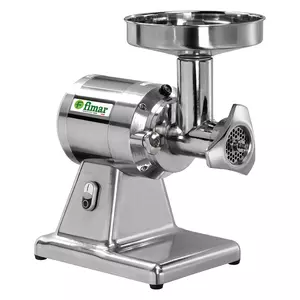
A professional meat mincer is a machine designed to:
-
process large quantities of meat (from 100 to 1000+ kg/h)
-
operate continuously
-
maintain strict hygiene standards
-
allow fast disassembly and cleaning
-
use standardized plates and knives
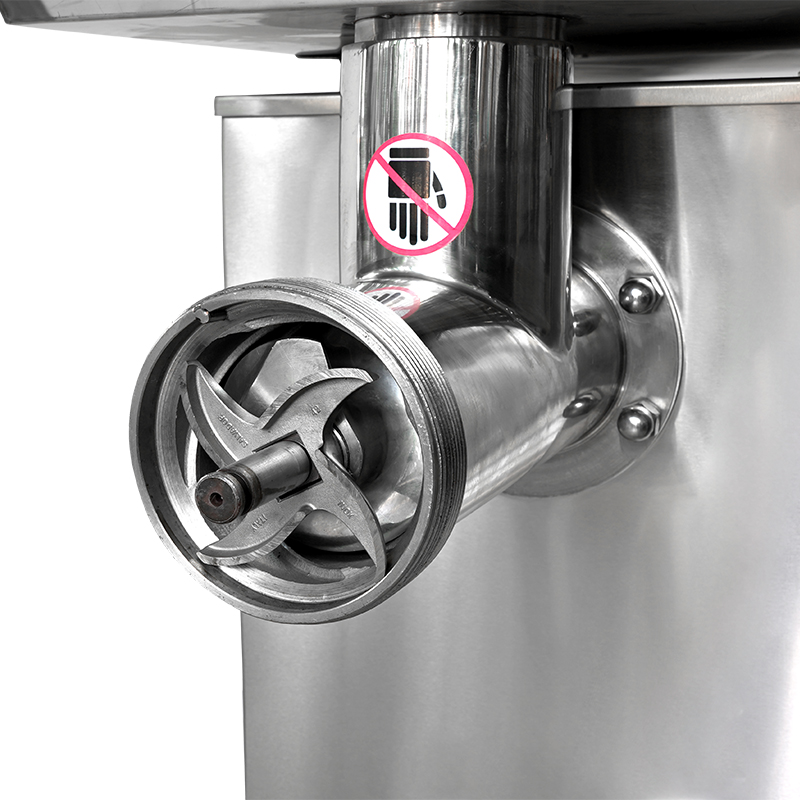
It consists of:
- grinding unit → housing + auger + knife + plate
- cutting system
- auger (screw) → the spiral mechanism that feeds the meat forward
- plates → the perforated grinding discs
- knives
- reducer (gearbox) → reduces motor speed and increases torque
- motor
- hopper → the upper tray for meat
- body (frame)
2. Grinding unit (housing) — aluminium or stainless steel?
The choice between aluminum and stainless steel housing of the grinding unit depends on the operating environment: intensity, cleaning agents and visual requirements. The internal parts (screw, knife, plate) are always made of stainless steel.
Aluminium grinding unit
| ✔ lighter | not suitable for washed in a dishwasher |
| ✔ cheaper | does not support the Unger system |
| ✔ suitable for standard workloads | less durable under intensive use |
Stainless steel grinding unit (AISI 304)
| ✔ highest hygiene | higher price |
| ✔ dishwasher‑safe | |
| ✔ more durable under heavy load | |
| ✔ supports the Unger system | |
| ✔ longer lifespan |
Recommendation:
- For butcher shops, supermarkets and production facilities → stainless steel
- For restaurants and medium workloads → aluminium
3. Cutting systems: Enterprise vs Unger
This is the internal assembly of knives and plates.
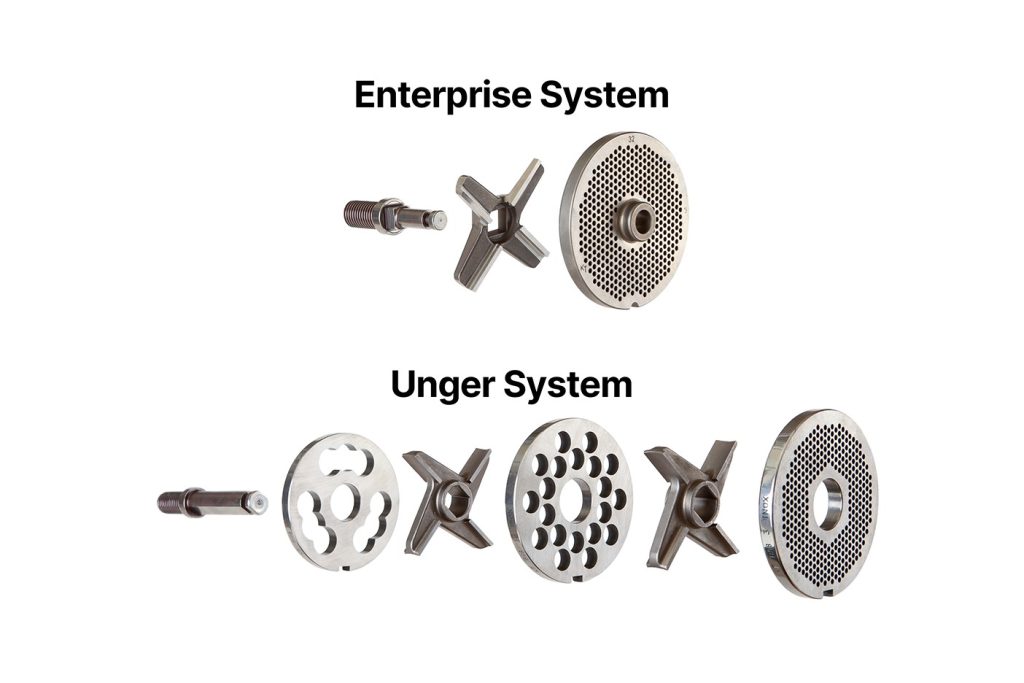
Enterprise system (standard)
In the Enterprise system, the meat grinder plate is located after a single knife. The knife is sharp only on the plate side. The meat is usually ground twice to ensure that the fat is well mixed with the muscle tissue. Depending on the application, the meat grinder plate usually has a hole size of 3 mm (fine grinding) or 6 mm (medium grinding).
1 knife + 1 plate
-
faster
-
easier to clean
-
standard on all machines
-
ideal for minced meat, kebab, kofta, burgers
Unger system (optional – only for stainless steel grinding units)
In the typical Unger two-blade (or 5-piece) system, you will first find a pre-cutting plate. After the pre-knife, there is a knife and a 13 mm (very coarsely ground) plate. Then comes another knife and the system ends with a 3 mm or 5 mm plate and a small spacer ring that holds the set in place. The knives are sharpened on both sides.
In the Unger single-blade (or 3-piece) version, the last knife and plate are replaced by a wide ring.
A multi‑component system (multiple knives + multiple plates):
-
finer grinding
-
more uniform texture
-
lower meat temperature
-
ideal for sausages, cured meats, delicatessen products
Important: Most manufacturers only offer the Unger system with stainless steel grinding units. This is because the Unger system is longer and heavier than the Enterprise and requires a stronger housing.
Practical recommendations
For best results with the Unger system, always keep the plates and knives in the same order and orientation after cleaning them. To maintain the correct arrangement, adjust the plates so that the inscription on each plate faces the same direction. Since the surfaces of the parts have slight irregularities, the mating surfaces of the plate and knife are ground over time to form a tight fit. If there are gaps, cutting performance will be poor.
In the Enterprise system, the support hub of the plate should be placed outward, not towards the knife, to avoid damage to the plate. Always replace both the plate and knife at the same time. The plate and blade wear out with use and form a tight pair, and replacing the blade alone results in poor performance. Enterprise plates and blades are thicker and can be sharpened before replacement.
4. Meat mincer numbering - meaning and standards
This is an international standard based on the diameter of the grinding plate.
| Size Number | Plate Diameter (Approx.) | Suitable Establishment / User | Best For |
|---|---|---|---|
| #5 | 52–53 mm (2 1/8") | Home Kitchens | Small batches, occasional burger making |
| #8 | 61–62 mm (2 1/2") | Serious Home Cooks / Hunters | Regular processing of venison or bulk beef |
| #10 / #12 | 69–70 mm (2 3/4") | Small Delis / Farm Shops | Daily small-batch sausage making |
| #22 | 82–83 mm (3 1/4") | Local Butcher Shops / Small Restaurants | Processing 200+ lbs of meat per hour |
| #32 | 99–100 mm (3 15/16") | High-Volume Butchers / Supermarkets | Continuous heavy-duty grinding (all day) |
| #42 | 128–130 mm (5 1/16") | Small Meat Packing Plants / Industrial | Massive volume, wholesale production |
The higher the number → the larger the plate diameter → the higher the throughput and the more powerful the machine.
The gold standard for professional use: #32


5. Motor power and performance
1.6 kW (300–500 kg/h)
Suitable for:
-
restaurants
-
small butcher shops
-
supermarkets with moderate workload
2.2 kW (300–500 kg/h, but more durable)
Suitable for:
-
butcher shops
-
supermarkets
-
small production facilities
-
intensive daily operation
3+ kW (500–1200 kg/h)
Suitable for:
-
industrial production
5.1 Single‑phase vs three‑phase machines — what should you choose?
It is important to understand that single‑phase and three‑phase meat mincers may have the same nominal power (watts), but they operate very differently. A three‑phase motor delivers power more evenly, has a higher starting torque, and works more stably under load. This allows the machine to run longer, quieter and with less heat build‑up — even when the wattage is identical.
This is a critical factor that customers often misunderstand.
Single‑phase (230V)
Suitable for:
-
restaurants
-
small kitchens
-
home use
-
locations without three‑phase power
Characteristics:
-
lower power
-
easier installation
-
lower price
-
less durable for continuous operation
Three‑phase (400V)
Suitable for:
-
butcher shops
-
supermarkets
-
production facilities
-
high‑load environments
Characteristics of three‑phase machines:
-
not higher wattage, but more stable power delivery
-
higher starting torque
-
smoother operation without power drops
-
quieter
-
longer motor lifespan
-
less overheating during prolonged use
6. Construction and materials
6.1 Body and hopper (top tray for meat)
Always choose stainless steel:
-
easier to clean
-
higher hygiene
-
longer lifespan
6.2 Gearbox (reducer)
The gearbox is the mechanical component that converts the motor’s high RPM into a slow but extremely powerful rotation of the auger. This allows the mincer to operate smoothly, without vibration or stalling — even when processing tougher cuts of meat.
Machines with an oil‑bath gearbox are:
-
quieter
-
more reliable
-
more durable
Avoid dry gearboxes.
Note on the auger (screw)
The auger is the spiral mechanism inside the grinding unit that pushes the meat toward the knife and plate. It ensures:
-
consistent feed
-
stable pressure
-
continuous grinding
The more massive and precisely machined the auger, the more stable and efficient the machine.
6.3 Cooling
A cooling fan is essential for intensive operation.
6.4 Safety features
-
micro‑switches
-
overload protection
-
reverse function
7. Plates and grids
| Size | Usege |
|---|---|
| 3–4 mm | fine grinding, pates |
| 6 mm | standard minced meat |
| 8 mm | coarser minced meat |
| 10–12 mm | sausages |
| 14–16 mm | coarse grinding, chorizo |
| 20+ mm | specialties |

8. Refrigerated meat mincers
Refrigerated meat mincers are a higher‑class category of professional machines designed for environments where meat stays in the hopper for longer periods or where the machine operates continuously. They have an integrated cooling system that keeps the temperature of the grinding unit and hopper within safe limits.
✔ What do they cool?
-
the grinding unit
-
the hopper
-
the housing around the auger
✔ Why is this important?
-
prevents bacterial growth
-
preserves the structure and quality of the meat
-
allows continuous operation
-
ideal for supermarkets, display counters and production facilities
✔ Examples
Here you can explore refrigerated mincer models No.22 and No.32, suitable for supermarkets and stores with a constant customer flow.
✔ When should you choose a refrigerated meat mincer?
-
when operating for more than 3–4 hours without interruption
-
when selling directly from a display counter
-
when high hygiene standards are required
-
when processing large quantities of meat
✔ When is it NOT needed?
-
restaurants
-
kitchens
-
butcher shops with portion‑based work
-
businesses that grind meat on demand
9. Semi‑professional meat mincers (Lacor)
These models are suitable for:
-
small restaurants
-
home kitchens
-
light workloads
Characteristics:
-
smaller grinding units
-
weaker motors
-
shorter duty cycles
-
not suitable for butcher shops or supermarkets
9.1 Professional vs semi‑professional meat mincer
Comparison Table: Professional vs Semi‑Professional Meat Mincers
| Feature | Professional Mincer | Semi‑Professional Mincer |
|---|---|---|
| Grinding unit size | Large (No.22 / No.32 / No.42) | Small (No.8 / No.12) |
| Material | Stainless steel (AISI 304) | Aluminium or mixed materials |
| Motor power | 1.6–3+ kW | 0.5–1.2 kW |
| Duty cycle | Continuous operation | Short cycles, needs rest |
| Cutting system | Enterprise or Unger | Enterprise only |
| Cooling | Optional (refrigerated models) | Not available |
| Suitable for | Butcher shops, supermarkets, production | Home use, small restaurants |
| Durability | Very high | Moderate |
| Price range | Higher | Lower |
10. How to choose the right model?
Restaurant → No.12 or No.22, 1.6 kW
Butcher shop → No.32, 1.6–2.2 kW, stainless steel grinding unit
Supermarket → No.32, 2.2 kW, stainless steel + Unger system
Production facility → No.42, 3+ kW, stainless steel, Unger system
11. Most common mistakes
- Buying an aluminium grinding unit for intensive work
- Choosing Enterprise when Unger is required
- Underestimating motor power
- No spare plates
- Choosing the wrong machine number
- Buying a non‑dishwasher‑safe grinding unit for high‑hygiene environments
12. Final checklist you can use
-
Machine number (12/22/32/42)
-
Grinding unit material (aluminium / stainless steel)
-
Cutting system (Enterprise / Unger)
-
Motor power (1.6 / 2.2 / 3+ kW)
-
Throughput (kg/h)
-
Cooling
-
Gearbox
-
Plates (hole sizes)
-
Hygiene (dishwasher‑safe components)
-
Spare parts availability
Ready to choose the right meat mincer for your business?
Explore the professional models at TIROL.bg and choose a machine that matches your workload, hygiene requirements and budget. → See all meat mincers
Useful internal and external resources
Internal links
External links
-
HACCP (Codex Alimentarius) Official international standard for hazard analysis and critical control points.
-
Regulation (ЕО) 853/2004 Defines temperatures, hygiene requirements and rules for equipment that comes into contact with meat.
-
Regulation (ЕО) 2073/2005 Specifies acceptable levels of bacteria in meat and meat products.
-
Regulation (ЕО) 1935/2004 Defines which materials are safe for food contact (incl. AISI 304, AISI 430).
-
EHEDG (European Hygienic Engineering & Design Group) European standard for hygienic equipment design in the food industry.
-
ISO 22000 nternational food safety standard combining HACCP and risk management.